

What a Commercial Roof Maintenance Program Includes and Whether
the Cost Makes Sense
A commercial roof maintenance program changes that from reactive to scheduled. It defines what gets done, how often, and what the documentation looks like, so the roof’s condition is a known variable in capital planning rather than a surprise on the balance sheet.
This guide covers what a complete program includes, what it costs, and how to make the internal case for one when the roof is not currently leaking.
Silicoat Roofing offers a free roof analysis for commercial buildings across the Detroit metro region as the starting point for any maintenance program.
What a Complete Commercial Roof Maintenance Program Includes
A commercial roof maintenance program is a defined schedule of inspections, minor repairs, and documentation performed by a certified contractor on a recurring basis. It is not a one-time inspection. It is not a service call when something breaks. It is a structured system with specific tasks assigned to specific intervals.
A complete program covers the following on every visit:
Biannual inspections with written documentation. Spring and fall visits are the standard cadence for commercial flat roofs. Each visit produces a written report with photographs, a condition assessment of every major component, and a prioritized list of any items requiring attention. The report is what protects warranty coverage, supports insurance claims, and anchors the capital planning conversation.
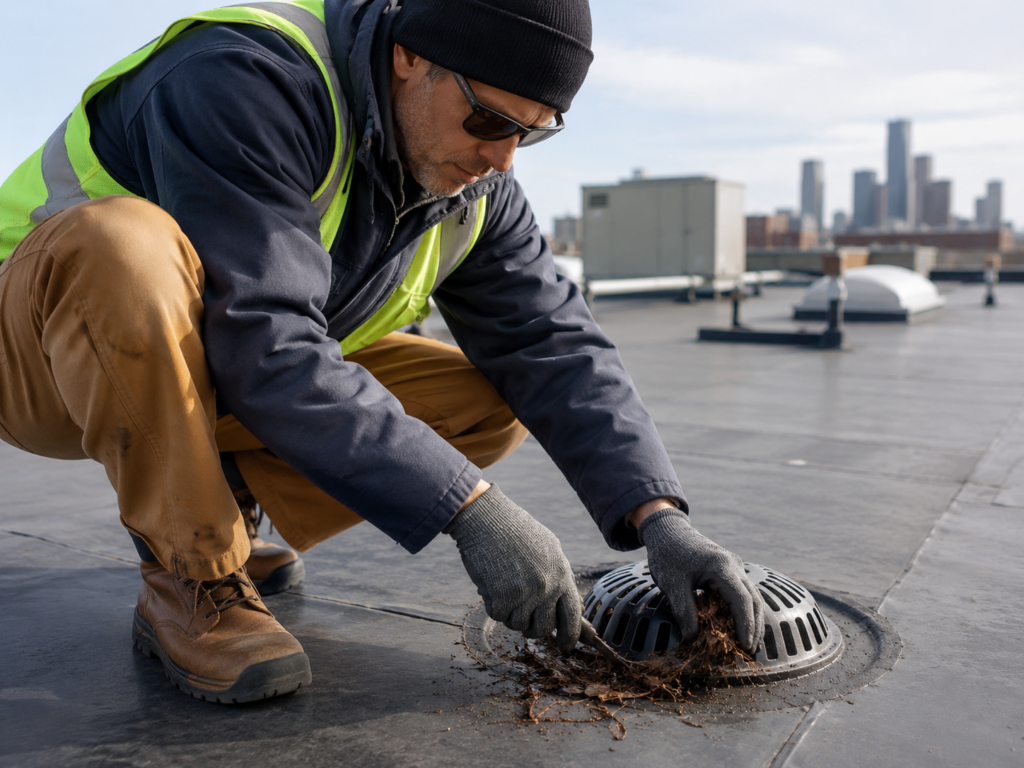
Drainage system maintenance. Clearing drains, scuppers, and gutters is not optional. Blocked drainage is the leading cause of preventable flat roof failures. Ponding water accelerates membrane wear, adds structural load, and voids most manufacturer warranties when left documented and unaddressed.
Seam and flashing inspection and minor resealing. Seams and flashings are where flat roofs fail first. A maintenance visit includes checking every lap seam and flashing transition for lifting, separation, or sealant breakdown, and making minor repairs on the spot rather than scheduling a separate service call.
Penetration seal inspection. Every HVAC curb, pipe boot, and rooftop equipment base is checked for sealant condition. Minor deterioration caught at a maintenance visit costs a fraction of what it costs after a winter of water infiltration.
Surface condition assessment. Membrane condition is documented each visit, including any new blistering, erosion, or areas of surface wear. Over multiple visits, the report history shows how the roof is aging and when restoration or replacement planning needs to begin.
Interior observation. A complete maintenance visit includes interior access to check for ceiling stains, insulation saturation, or any evidence of active moisture. Leaks travel. What shows up inside the building is often not directly below the roof entry point.
Silicoat Roofing’s commercial roof inspection services form the foundation of every maintenance visit, with the written report structured to satisfy both warranty documentation requirements and insurance carrier requests.
How to Justify a Maintenance Program When Nothing Is Visibly Wrong
This is the conversation most facility managers dread: explaining to ownership why the building needs to spend money on a roof that is not currently leaking.
The case is straightforward when it is framed around consequences rather than roofing theory.
Emergency repairs cost dramatically more than scheduled maintenance. A seam repair addressed during a routine visit costs a fraction of what it costs after a winter of water infiltration has saturated the surrounding insulation and required interior remediation as well. The problem is the same. The timing is different. The cost is not.
Proactive maintenance extends roof service life substantially. Research from the National Roofing Contractors Association and the American Institute of Plant Engineers consistently shows that maintained commercial roofs serve significantly longer than unmanaged systems. Years of additional service life before a full replacement capital expense is required translates directly into deferred expenditure that stays off the capital plan.
A documented maintenance record protects the budget in two directions. It keeps the warranty valid, which protects against paying out of pocket for failures that should be covered. It also establishes a pre-storm condition baseline that insurance carriers need when processing storm damage claims. Without that record, neither protection exists when it is needed.
The internal case is not “the roof might leak.” It is “a maintenance program extends the roof’s service life by years, keeps our warranty in force, and protects our insurance position in the meantime.” That is the framing that moves a budget conversation.
Warranty Compliance and What a Maintenance Program Protects
A maintenance program does not just extend roof life. It protects coverage that already exists.
Most commercial roofing manufacturer warranties require documented regular maintenance as a condition of coverage. A gap in the inspection and maintenance record gives the warranty provider grounds to decline a claim, regardless of whether the failure was caused by a material defect or contractor error. As covered in detail in roof warranty inspection requirements, the inspection record needs to include timestamped photographs, location-referenced findings, and documentation of any repairs made since the prior visit.
A maintenance program that produces this documentation after every visit is not just good roofing practice. It is warranty administration. The two are inseparable for any commercial roof under a manufacturer warranty.
The same logic applies to insurance. Carriers increasingly request documented maintenance history before paying storm damage claims. A pre-storm maintenance record establishes what condition the roof was in before the weather event, which is the baseline any adjuster comparison requires. Without it, a carrier can classify damage as pre-existing or attribute it to neglect.
When to Start and How Often to Run the Program
The right time to start a maintenance program is before a problem is identified, not after. Once a leak has appeared, the maintenance program that follows is managing a known issue rather than preventing unknown ones.
For Detroit metro commercial buildings, the Michigan climate creates a clear maintenance calendar. Freeze-thaw cycles run from November through March and put repeated thermal stress on membrane seams, flashings, and penetrations. Snow loads add structural pressure to flat roof systems. Spring inspections should happen in April to assess winter damage before the rain season compounds it. Fall inspections should happen in September or early October, while contractor availability is still workable and before temperatures make roof work difficult.
Beyond the twice-yearly schedule, three situations call for an unscheduled visit: after any hail or high-wind event, when a tenant reports interior moisture or ceiling staining, and before a property transaction where the inspection record feeds into due diligence.
The program should be formally reviewed once a year. As a roof ages, the scope and frequency of maintenance visits may need to increase. A roof at year five of a 20-year system has different needs than the same roof at year fifteen, and the maintenance program should reflect that.
Frequently Asked Questions
What does a commercial roof maintenance program include?
A complete commercial roof maintenance program includes biannual inspections with written reports, drainage system clearing, seam and flashing inspection and minor resealing, penetration seal checks, surface condition documentation, and interior observation for moisture. Each visit produces a written report with photographs that satisfies warranty documentation requirements and supports insurance claims.
How much does a commercial roof maintenance program cost?
Commercial roof maintenance programs are typically priced per square foot per year or as an annual contract. The cost varies based on roof size, complexity, and what the program includes, specifically whether it covers minor repairs in addition to inspections, and whether each visit produces a written report. Getting an itemized quote is the only way to compare programs accurately, since scope differences make price-only comparisons misleading.
How often does a commercial roof need maintenance?
Twice a year is the standard for commercial flat roofs, with spring and fall visits aligned to Michigan’s seasonal damage patterns. Spring inspections assess freeze-thaw and snow load damage. Fall inspections confirm the roof is ready for the next winter. Additional visits are warranted after severe weather events or any reported interior moisture.
Does a maintenance program actually extend roof life?
Yes. Research from the NRCA and the Association for Facilities Engineering shows that maintenance can extend a commercial roof’s service life by 30% to 100%, depending on the roofing system and climate.
Can I run a maintenance program myself or does it need a contractor?
Basic visual checks by building staff between professional visits are useful for catching obvious issues like debris accumulation or visible membrane damage. They do not replace professional maintenance. Warranty documentation requirements specify inspections by certified contractors. Insurance carriers apply the same standard. A maintenance program that does not produce documentation from a certified contractor does not satisfy either requirement.
Starting a Program That Actually Holds Up
A commercial roof maintenance program is the difference between a roof that delivers its full expected service life and one that ends a capital planning conversation three years earlier than it should. The cost of the program is not the question. The cost of not having one is.
Silicoat Roofing is a commercial roof coating company in Troy, Michigan serving the Detroit metro region with 20+ years of expertise in commercial roof inspection, restoration, repair, and maintenance. Every maintenance program Silicoat runs produces the written documentation that satisfies warranty requirements and protects insurance position. For roofs that qualify for restoration, the work is backed by Silicoat’s 20 Year Leak-Free Guarantee, and the company documents restoration costs at up to half the cost of traditional replacement on comparable commercial buildings.
Ready to find out what your roof is actually costing you? Silicoat Roofing offers a free roof analysis for commercial buildings across the Detroit metro region: https://silicoatroofing.com/contact/
About the Author
Rick Dodaj is the founder and CEO of Silicoat Roofing, specializing in commercial roofing solutions that protect businesses and their investments. With extensive experience in commercial roofing, Rick leads a team dedicated to providing cost-effective, long-lasting roofing solutions.
 Previous Post