
Commercial Roof Restoration Services
Commercial Roof Restoration for Flat and Low-Slope Buildings
Most commercial roofs that get replaced didn’t have to be. Silicoat Roofing‘s restoration process repairs, seals, and coats your existing roof system, extending its service life at a fraction of replacement cost.
Why Property Owners Trust Us

We use the latest technology and techniques to keep your roof in optimal condition.
Replacement quotes have a way of arriving at the worst possible time. Maybe you’ve been there: your roof has been on the watch list for a season or two, repair and maintenance have patched what it could, and then a bad storm or a persistent leak forces the issue. Suddenly, there is a six-figure number sitting in front of a budget that wasn’t built for it. Commercial roof restoration is often the option nobody mentioned, one that delivers equivalent performance at a fraction of replacement cost. What it takes is someone who will actually walk the roof with a moisture scanner before writing a proposal.
What Commercial Roof Restoration Actually Involves
It is a full-system process that begins with a detailed inspection, moves through surface preparation and targeted repairs, and concludes with the application of a seamless protective coating system engineered for commercial roofing materials. The result is a roof that performs comparably to a new installation, but without the cost, waste, or disruption of a tear-off.
Restoration vs. Replacement
Restoration is not the right answer for everyone. Commercial roof restoration typically ranges from $3 to $7 per square foot, depending on roof size, membrane type, and the extent of repairs required before coating. Full replacement in the same building generally ranges from $10 to $20 per square foot once tear-off labor, disposal, and new materials are factored in. That gap is where restoration makes its case.
The range is real because no two roofs come in with the same condition. A 20,000-square-foot TPO roof with isolated seam failures and dry insulation sits at a very different starting point than one with multiple penetration failures and a section of saturated substrate that needs to be cut out and replaced before coating begins. Silicoat’s free assessment produces a written estimate with a full line-item breakdown, so you’re comparing actual numbers against your replacement quote, not ballpark against ballpark.
How the Process Works
The restoration process is structured and documented at every stage. For a facility manager who needs to plan around occupied building operations, that predictability matters as much as the end result.
1. Assessment and Project Planning
A technician inspects the full roofing system (surfaces, flashings, penetrations, and drainage patterns), combined with moisture scanning to detect trapped water beneath the membrane. Findings are photographed and documented, then used to build a project proposal with a detailed cost breakdown, timeline, and warranty options. Nothing proceeds without the building owner’s sign-off.
2. Surface Preparation and Repairs
Proper prep is where long-term coating performance is won or lost. Most premature coating failures trace back to this step being rushed. The surface is cleaned using methods appropriate to the specific roofing material, then every identified deficiency is addressed: seam repairs, flashing repairs, replacement of saturated insulation sections, and reinforcement of weak areas with fabric and liquid flashing. The coating goes on after the problems are fixed, not over them.
3. Coating Application
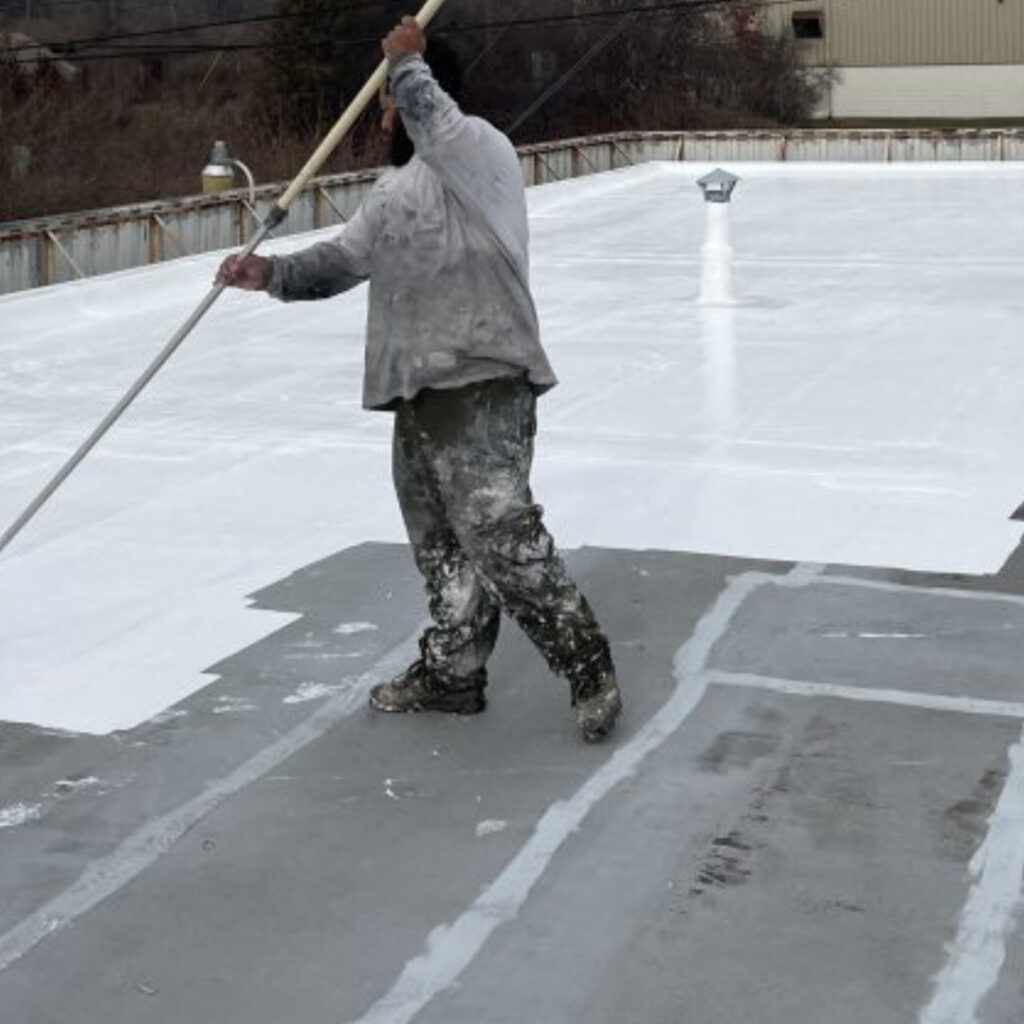
The coating system is applied in layers. Airless sprayers for field coverage, rollers for detail work, brushes at penetrations and flashings. Each one cures fully before the next is applied, so that the finished system delivers UV protection, waterproofing, cold-weather flexibility, and resistance to environmental contaminants.
4. Quality Control and Final Walkthrough
Thickness and adhesion testing confirm the material was applied to specification. The building owner or facility manager walks through the completed work with the Silicoat team, full project documentation is handed over, and a warranty and maintenance plan is provided on completion.
Is This the Right Fit for Your Building
Restoration works well when the membrane is structurally intact, moisture scanning shows dry insulation, and the issues are surface-level. It also makes practical sense when full replacement is not viable in the current capital planning cycle.
Replacement is the more appropriate choice when insulation is saturated across large sections of the roof, when the structural deck is compromised, or when the membrane has failed systemically rather than at specific points. A roof that has already been restored multiple times and is nearing the end of its life will also reach a point where another coating cycle stops making economic sense. For many building owners, that honest conversation is actually the most useful thing Silicoat can offer, because knowing what you are not dealing with is just as valuable as knowing what you are.
Silicoat’s inspection is designed to give you a straight answer on which situation applies to your building.

TPO and EPDM Roof Restoration: What Property Owners Should Know
These are the two membrane types Silicoat encounters most often on Michigan commercial roofs, and both respond well to restoration when the substrate underneath is sound.
TPO’s factory-welded seams and reflective surface make it a strong coating candidate, provided seam integrity is confirmed and the surface is properly cleaned before any product is applied.
EPDM requires a different approach: because the membrane is inherently non-porous, coating adhesion depends on a specific primer application that chemically prepares the surface for bonding. Skipping or rushing that step is one of the more common reasons EPDM restoration jobs underperform, and it is something Silicoat’s prep process accounts for before the first coat goes down.
What Building Owners Say Changes the Conversation
For most clients, the turning point is the moisture scan result. A roof that looks rough at the surface (one that a previous contractor may have written off as a replacement) often has completely dry insulation underneath. That one finding shifts the entire economic picture, and it is the kind of detail that only shows up when someone is actually looking for it rather than arriving with a predetermined recommendation.
Silicoat Roofing has worked with commercial property owners across Michigan for over 20 years, across roofing systems that range from standard flat roofs on retail and industrial roofing solutions to more complex multi-section roofs on manufacturing and institutional facilities. That breadth shows up in the assessment process, in knowing the difference between a failing membrane and a failed seam, and in understanding how a coating system performs differently on a 10-year-old TPO roof compared to a 25-year-old modified bitumen system.
“Most building owners we meet have already been told they need a full replacement. What we find, more often than not, is that the substrate is sound and the real problem is at the surface or the flashings. Restoration in those cases gets you the same outcome as a new roof at a fraction of the cost, but only if the prep work is done properly and the coating system is matched to the specific membrane. That is the part that gets skipped when contractors are moving too fast.” – Rick Dodaj, Founder of Silicoat Roofing.
FAQ About Commercial Roof Restoration
Commercial roof restoration is a process that cleans, repairs, and applies a protective coating system over an existing commercial roof membrane, extending its service life without a full tear-off. It applies to most flat and low-slope roofing systems, including TPO, EPDM, modified bitumen, metal, BUR, and PVC, provided the substrate is structurally sound.
Your roof qualifies if the insulation is dry, the structural deck is intact, and the membrane retains enough integrity to bond with a coating system. Silicoat Roofing determines eligibility through a detailed commercial roof inspection that includes moisture scanning. Roofs with widespread saturated insulation or structural deck damage are generally not candidates.
A properly executed commercial roof restoration can extend a roof’s service life by up to 10 to 20 years, depending on the coating system used and the condition of the underlying membrane at the time of work. Silicoat provides a warranty and maintenance plan on completed restoration projects. The exact outcome varies by roof type, substrate condition, and how well the system is maintained afterward.
Restoration typically costs significantly less than full replacement because it eliminates tear-off labor, disposal fees, and a completely new roofing system. The exact figure depends on roof size, condition, and the coating system required. Silicoat provides a detailed written estimate following the free assessment, with a full cost breakdown before any work is approved.
Most commercial roof restoration projects are completed in a few days to a few weeks, depending on roof size, complexity, and weather conditions. Because restoration eliminates the tear-off phase, it is substantially faster than replacement and creates minimal disruption to building operations. Silicoat coordinates scheduling around your operational requirements from the start.
Yes. The coating systems Silicoat uses are engineered for cold-weather flexibility, allowing them to expand and contract with Michigan’s temperature swings without cracking or delaminating. Application during appropriate temperature windows is built into Silicoat’s project planning process, not treated as an afterthought once the job is already scheduled.
Your Roof Has Already Told You Something
A leaking or deteriorating commercial roof is not automatically a replacement project. For buildings where the substrate is intact, commercial roof restoration delivers equivalent performance at substantially lower cost, with less operational disruption and none of the landfill waste a full tear-off generates. The assessment is what determines whether your building qualifies, and that assessment is free.
If you want a straight answer on what your roof actually needs, Silicoat Roofing is ready to take a look. Contact us to schedule your free commercial roof assessment.
Contact us
Schedule Your Free Roof Analysis
Schedule Your Free Roof Analysis
Get in touch with us today by filling out this form. One of our skilled professionals will reach out to you shortly to discuss your commercial roofing needs and schedule your free roof analysis. We look forward to hearing from you!