
Why a Commercial Roof Leak After Heavy Rain Is Rarely a Hole
The building is dry through a week of drizzle. Then one storm comes through, and by the next morning a stain is spreading across a ceiling tile in the warehouse. By the time anyone gets up on the roof, it has stopped, the surface looks fine, and nobody can find anything wrong with it.
That pattern frustrates facility managers more than a leak that runs constantly, because there is nothing to point at. A commercial roof leak after heavy rain is also the most informative kind of leak you can have, once you know what it is telling you.
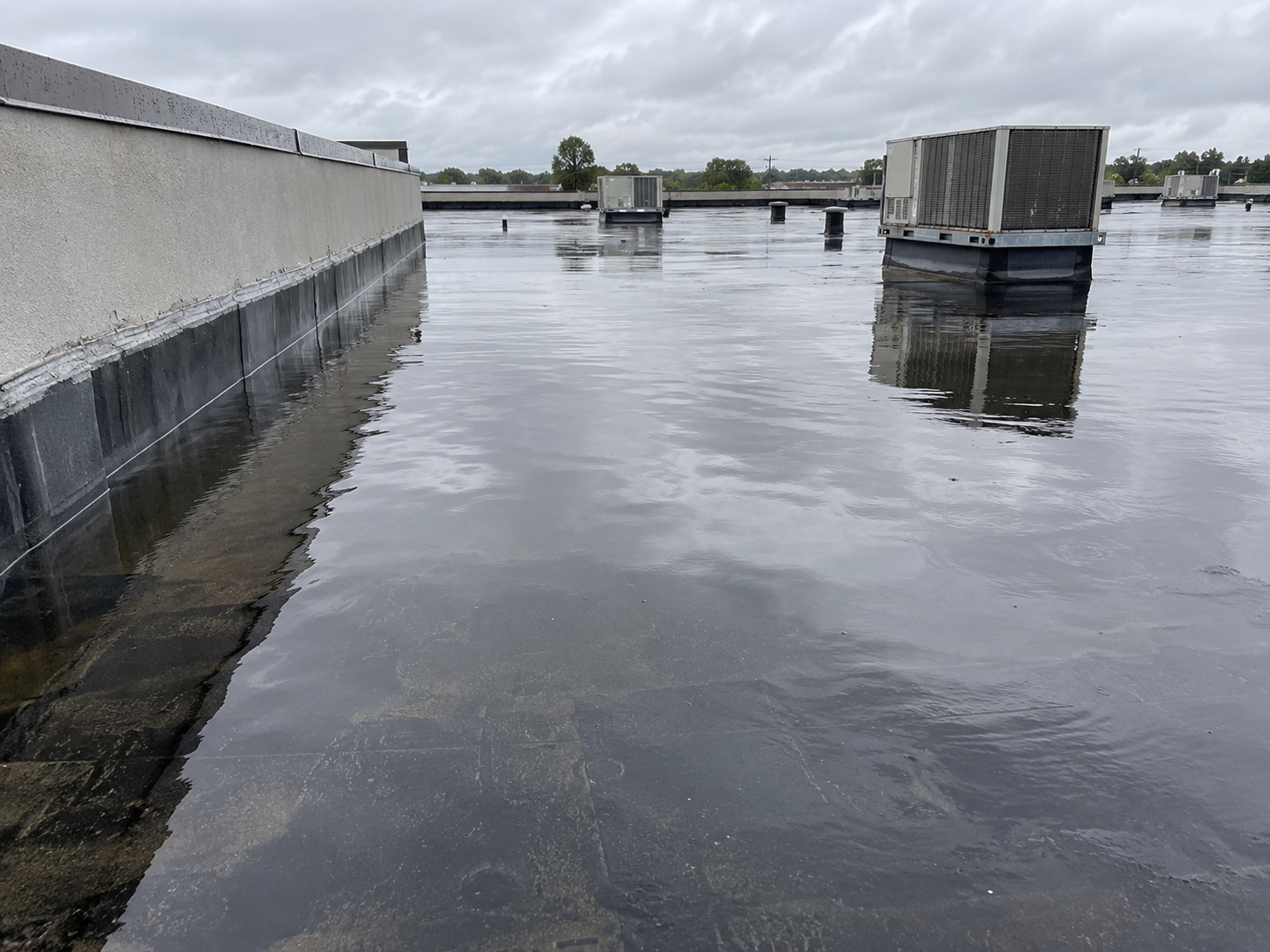
It is rarely a hole. A hole leaks whenever water lands on it. What you are almost certainly looking at is a capacity problem. Water is backing up above the level the roof was built to hold it at, and reaching details that are watertight at normal water levels and not watertight above them.
This page covers what changes when rainfall gets intense, which details fail first when it does, and how to find the source on a roof that looks fine by the time anyone inspects it.
What Changes When Rainfall Gets Intense
Nothing about the roof changes during a storm. What changes is how fast water arrives compared with how fast the roof can move it away, and every leak in this category comes out of that gap.
Drains Reach Their Limit
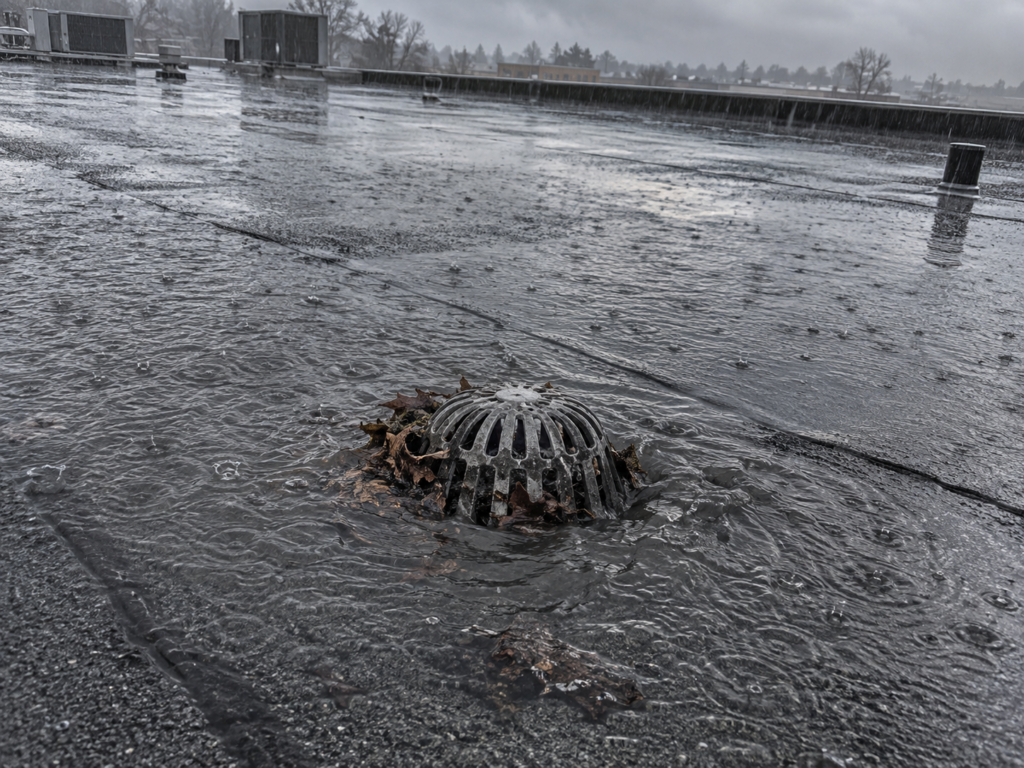
Roof drainage is sized to a rainfall rate, not to rain in general. Codes have required drainage to be designed against the 15-minute duration rainfall rate since 1991, meaning the volume that falls in a quarter of an hour in a once-in-a-century event. That standard is roughly double the one-hour rate used before it, and it exists because short violent bursts are what overwhelm a roof, not total accumulated inches.
When arrival outpaces outflow, the water level on the roof rises. That is not a defect. That is the system working as designed while it waits its turn.
The Water Level Rises Above Design Height
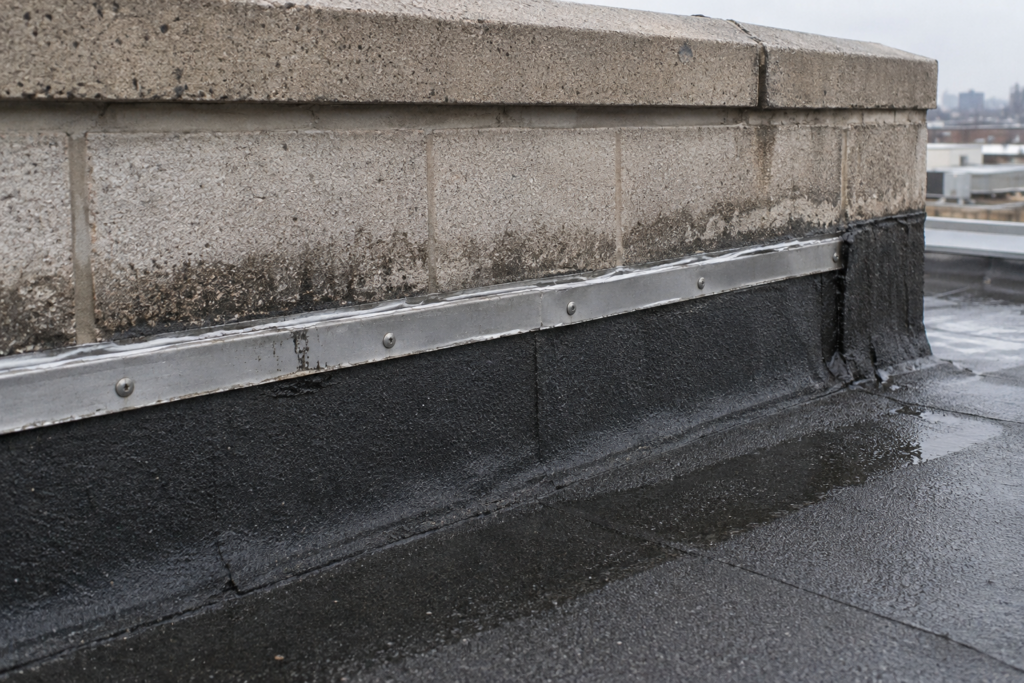
Here is the mechanism most building owners have never had explained. A commercial roof is not a sealed tank. It is an assembly of surfaces, laps, terminations, and upstands, each watertight up to a certain height. Base flashing has a top edge. A curb has a height above deck. A lap has an edge. All of those sit above where water normally sits, so they are never tested.
Raise the water two or three inches for twenty minutes and details that have been fine for fifteen years are suddenly underwater. Water finds the one that was slightly short, or slightly loose, or was fine until the sealant went. Then the rain stops, the level drops, everything is dry again, and the roof looks blameless.
Wind Arrives With the Rain
Heavy rain in the Detroit metro usually comes with wind, and wind drives water sideways and upward into details built to shed it downward. Anything with a vertical face takes water at pressure rather than by gravity: base flashings, counterflashing laps, the upstand behind rooftop units, parapet caps. A joint that sheds falling water can admit driven water.
The Failure Points That Open Up Under Load
Five details account for most failures in this pattern. They are worth knowing by name, because it changes what you ask for when you call somebody.
| Failure point | Why heavy rain finds it | What you would see |
|---|---|---|
| Drains, strainers and sumps | Debris that passes unnoticed in light rain becomes a dam at volume. A partly blocked strainer halves capacity exactly when it is needed | Water standing near a drain hours after rain, or debris ringing the dome |
| Missing or undersized overflow provision | Code sizes secondary drainage on the 100 year 15 minute rate and does not let you count the primary system toward it. If overflow is absent or set too high, water has nowhere to go but up | No visible scupper or overflow drain, or one set well above the parapet base |
| Base flashing terminations | The top edge is only ever tested when the water level rises to it | Stains appearing at wall or parapet junctions rather than in the field |
| Curbs and penetrations | Rooftop unit curbs, vent stacks and conduit are the most worked details on a roof and the ones most often altered after installation | Interior stain sitting below or near a rooftop unit |
| Seams and laps | Ageing adhesion at a lap edge holds against runoff and fails under standing water and driven rain | Linear stain patterns rather than a single point |
The pattern worth noticing is that three of those five are drainage, not membrane. On a commercial flat roof leak that only appears in heavy rain, the membrane is often doing its job, and the drainage is not. That distinction matters because it is the difference between a repair quote and a drain that needed clearing, and the two are not close in cost.
It also explains why these leaks are so often misdiagnosed. A contractor called out after the fact sees a dry roof and an intact membrane, finds nothing, and either quotes for exploratory work or suggests waiting to see whether it recurs. Both are reasonable responses to the wrong question. The right question is not where the membrane is damaged. It is how high the water got and what it reached on the way up.
How to Find the Source When the Roof Looks Fine
Finding a leak that only appears in heavy rain is harder than finding a constant one, because the condition that causes it is not present when anyone is up there looking. Commercial roof leak detection on this kind of failure works backwards from the conditions rather than forwards from the stain.
That means three things in practice. Interior evidence gets documented while it is happening, including time, duration, and rainfall, because a leak that appears twenty minutes into a downpour and stops fifteen minutes after tells you something a dried stain cannot. The roof gets walked with drainage as the subject rather than the membrane, checking strainers, sump condition, overflow height and standing water marks. And where the source still will not present itself, controlled flood testing or a moisture survey establishes what a visual inspection cannot, which is how far water has already travelled inside the assembly.
The one thing that reliably does not work is looking directly above the stain. On a low-slope roof, water enters at one point and travels along the deck or beneath the insulation before it finds a seam to come through. The stain marks the exit.
What to Do Before the Next Storm
Most of this category is preventable, and the preventable part is unglamorous. Drains cleared, and strainers checked before spring and again before autumn. Overflow provision confirmed to exist and to be at the right height. Flashing terminations and curb details looked at once a year rather than after a failure. Debris cleared after storms rather than left to migrate toward the drains during the next one.
None of that is a sales pitch for anything expensive. It is the reason a scheduled program of commercial roof repair and maintenance costs less over five years than the reactive version, and it is particularly true in Michigan, where anything left open in autumn gets frozen open over winter.
The timing that matters most is the autumn clear. Leaves and debris arrive at the drains in October and November, which is also when rainfall is still heavy enough to test capacity. A roof that goes into December with partly blocked strainers spends the whole winter with water sitting where it should not, freezing and expanding in every detail it reaches. By the time the spring storms arrive, the roof has had four months of damage that nobody watched happen, and the leak that shows up in April gets blamed on the April storm.
If you do one thing on this page, make it the autumn drain clear. It is the cheapest intervention available, and it prevents the largest share of what follows.
If water is entering the building right now, that is a different situation, and it is handled differently. Emergency commercial roof repair in Detroit is about stopping entry first and diagnosing afterwards. The diagnostic work on this page is what happens once the building is dry.
When Recurring Storm Leaks Mean Something Bigger
One leak traced to one cause is a repair. The signal worth acting on is repetition. A roof that produces a new leak in a different area after every significant storm is not giving you a series of unrelated failures. It is telling you the assembly has reached the point where its details no longer hold under load, and patching each one buys months.
At that stage, the question changes from what is leaking to whether continued repair is the right spend. Where the membrane is weathered throughout but the deck and insulation below are still dry, commercial roof restoration over an existing roof addresses the whole surface at once rather than chasing details individually, and is documented by this company at up to half the cost of a full tear-off and replacement, established at survey rather than promised in advance. Restored roofs carry the 20 Year Leak-Free Guarantee.
The timing constraint is worth understanding. That option depends on the insulation being dry enough to work with. Every storm season that passes with water entering the assembly narrows it, which is why recurring storm leaks are worth addressing on a schedule rather than after the next one. Standing water accelerates the same process, which is covered in more detail in ponding water on a flat roof.
Common Questions About Storm-Related Roof Leaks
Why does the roof only leak in heavy rain and not light rain?
Because the cause is usually water level rather than a hole. Light rain drains as fast as it arrives, so the water never reaches the flashing edges, lap terminations, and curb bases that sit above the normal water line. Heavy rain raises the level until those details are submerged.
The leak stopped on its own. Is the problem gone?
No. It stopped because the water level dropped, not because anything was repaired. The same conditions will produce the same leak in the next comparable storm, and each cycle moves more water into the insulation, where it does not dry out on its own.
Can a blocked drain really cause a leak?
Yes, and it is one of the more common causes. A partly blocked strainer cuts capacity at exactly the moment capacity matters. Water backs up, rises above details that are watertight only below a certain height, and enters there rather than at any point of damage.
How long after a storm should we inspect?
Within 48 hours, and while evidence is still present. Water standing on the roof two days after rain indicates a drainage problem in its own right. Interior evidence is also more useful when fresh, because the shape and spread of a stain say more before it dries.
Is storm damage covered by insurance?
It depends on the cause. Sudden storm or wind damage is commonly covered, while gradual deterioration and deferred maintenance commonly are not. A leak traced to a blocked drain tends to be treated as maintenance. Photograph conditions before anything is cleared or repaired, because the evidence is what the determination rests on.
Should we wait for the next storm to confirm the diagnosis?
Not if it can be avoided. Controlled flood testing reproduces the conditions without waiting for weather, and a moisture survey establishes how far water has already spread. Waiting for the next storm means another cycle of water entering the assembly before anything is fixed.
What a Commercial Roof Leak After Heavy Rain Is Telling You
It is a diagnosis waiting to be made rather than a mystery. The roof only fails under a specific condition, which narrows the list considerably, and on most buildings the answer is in the drainage rather than the membrane.
The practical step is looking while the conditions that cause it are understood, rather than waiting for a storm severe enough that the answer becomes obvious. Silicoat Roofing is a commercial roof coating company in Troy, Michigan, serving the Detroit metro region, with over 20 years of commercial and industrial roofing behind a restore-before-replace approach.
Ready to find out what your roof is actually costing you? Silicoat Roofing offers a free roof analysis for commercial buildings: https://silicoatroofing.com/contact/
 Previous Post