

What Flat Roof Repair Cost Comes Down To on a Commercial Building
Water is coming through somewhere, you have a contractor’s quote, and you have no way to tell whether it’s fair. Flat roof repair cost is hard to judge because the thing being priced is mostly invisible. The contractor is quoting what they think is wrong based on what they could see, and what they could see is the exit point, not the entry.
That is the whole difficulty. On a low-slope commercial roof, water enters at one place, travels along the deck or under the insulation, and comes out wherever it finds a seam. The stain on your ceiling tile marks the end of the journey. A repair priced from the stain is a repair priced from the wrong location.
What follows is what actually sets the number, how the same leak ends up with three different prices, and the point at which another repair stops being the cheaper choice.
Commercial roof repair and maintenance
What Sets the Price of a Flat Roof Repair
Flat roof repair cost on a commercial building is set by four things: what failed, how far the water spread before anyone found it, whether the insulation underneath stayed dry, and how hard the area is to reach. Material is rarely the driver. A tube of sealant costs almost nothing. Finding the breach and establishing how much of the assembly is wet is where the hours go.
That last part is the one owners are least prepared for. A membrane repair fixes the opening. It does nothing for insulation that has been holding water for two winters, and wet insulation does not dry out under a new patch. It stays wet, it keeps the deck damp, and it shows up again two bays over the following spring.
So the useful question when a quote arrives is not what the repair costs. It is what the contractor found when they went up there, and how they established it.
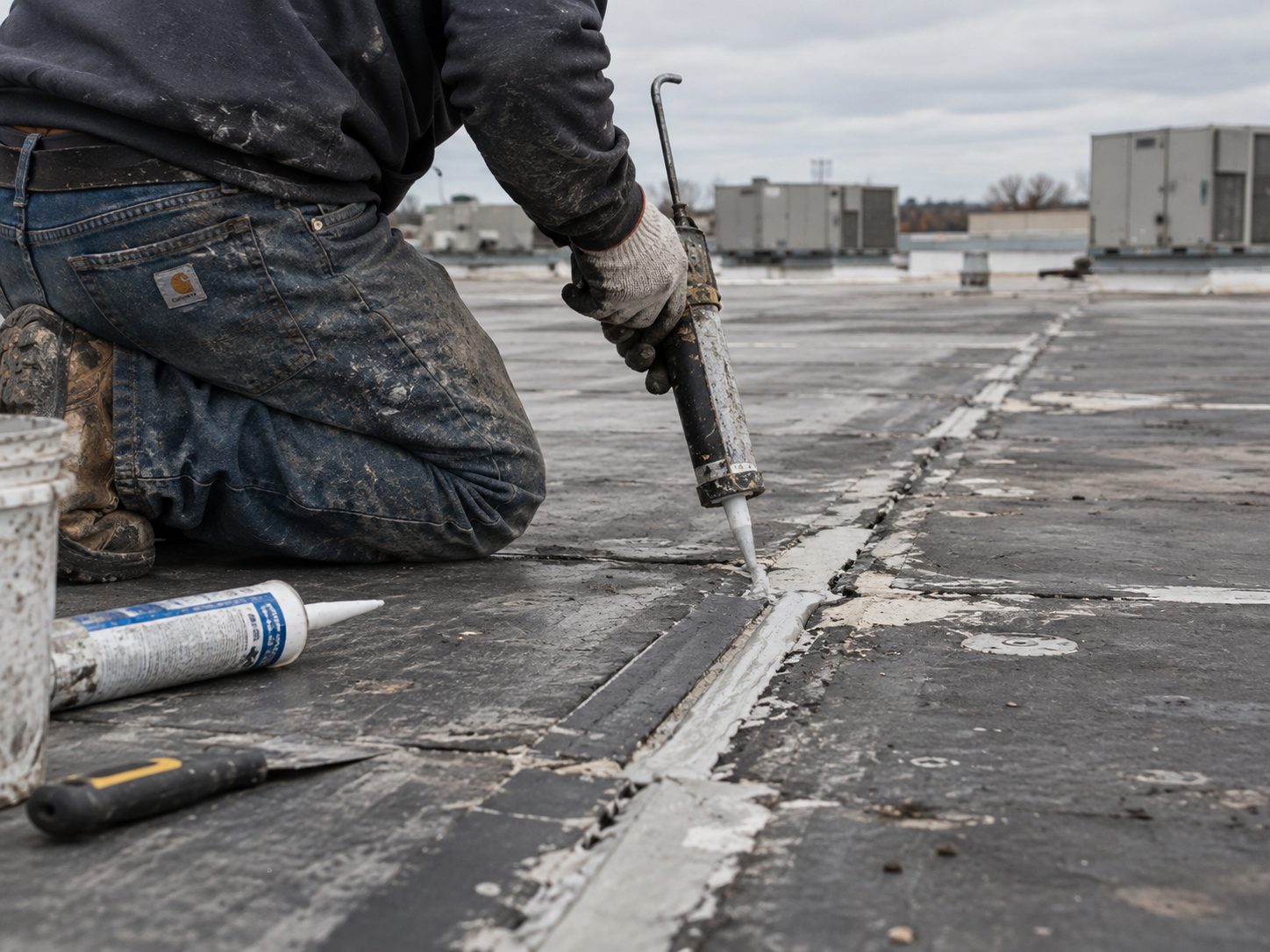
The Five Failure Types and What Each One Takes
Most commercial flat roof repairs fall into five categories. They are not priced alike, and knowing which one you have tells you roughly where in the range to expect the number.
| What failed | Why it happened | What the repair involves | Where it sits on cost |
|---|---|---|---|
| Open seam | Thermal movement, poor welding at install, or age | Clean, re-weld or patch the seam, check adjoining seams for the same condition | Lower, if caught before water spread |
| Membrane split or puncture | Foot traffic, dropped tools, rooftop trades working without protection | Patch the opening, inspect the insulation underneath for saturation | Lower to mid, depending on what is under it |
| Failed flashing at a penetration | Sealant at the end of its life, or a unit installed and never properly flashed | Strip and rebuild the flashing detail, not just reseal it | Mid. Rebuilding a detail costs more than sealing one, and lasts |
| Blocked or failed drainage | Debris, crushed drain, or a low spot that was always there | Clear or rebuild the drain, address the ponding that caused the surrounding damage | Mid to high, because the cause is usually not local to the symptom |
| Saturated insulation across an area | Any of the above, left long enough | Cut out and replace the wet insulation before anything goes back on top | Highest. This is the point where repair starts competing with restoration |
The pattern in that table is worth noticing. The first two rows are cheap when they are caught early and expensive when they are not. The failure itself does not get more expensive. The wet area around it does.
Why the Same Leak Gets Three Different Prices
Collect three quotes for one leak, and they will often come back far apart. That is usually not three different prices for the same work. It is three different assumptions about what the work is.
The cheapest quote is frequently the one where nobody established the extent of the moisture. It prices the visible failure, and it is accurate right up until the crew opens the roof. The middle quote often includes an allowance for what might be underneath. The highest quote is sometimes the only one where somebody took a core sample and priced what is actually there.
Three things separate a quote with a number in it from a quote with a method behind it:
Did they find the entry point or the exit point? A contractor who quotes from the interior stain has not traced the leak. On a low-slope roof, the breach can be thirty feet away.
Did they check the insulation? A core sample cuts through the assembly to the deck so the layers can be counted and the insulation physically checked. An infrared survey maps where moisture has spread across the wider roof. Without one of those, the biggest variable in the job has been estimated.
Does the quote say what happens if they find more? Conditions change once a roof is open. The difference between a reasonable contractor and a frustrating one is whether that was priced as a process or left as a surprise.
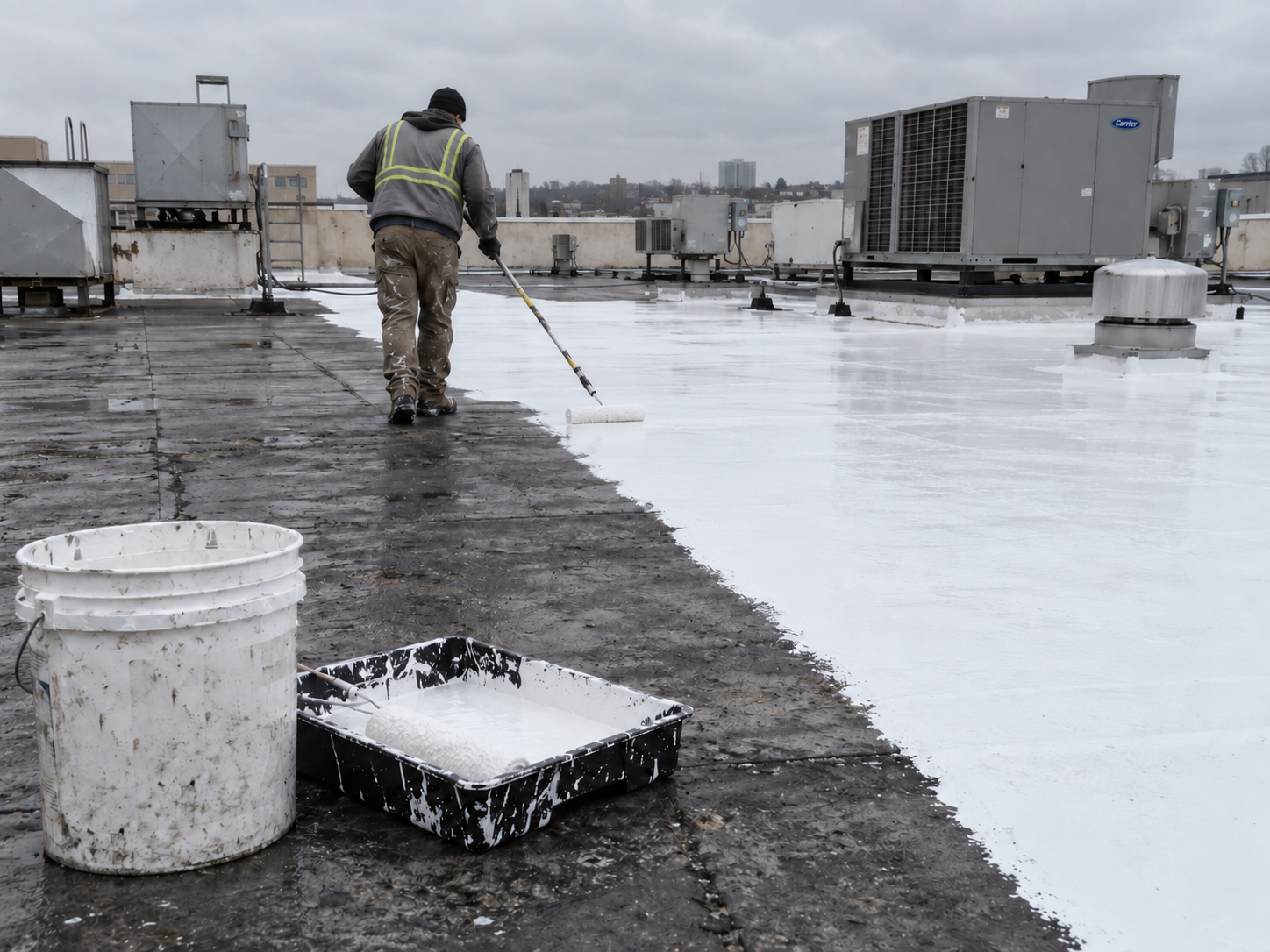
When Another Repair Stops Being the Cheaper Option
One failure traceable to one cause is a repair. That is true whatever the roof’s age.
Three separate leaks in eighteen months, in different areas of the same roof, are not three repairs. It is a membrane telling you it has reached the end of its service life. At that stage, each patch buys months rather than years, and the money going into them would go further somewhere else.
The decision point is the insulation. While the membrane is weathered, the insulation underneath is still dry, a liquid silicone membrane can go over the existing roof. There is no tear-off, no disposal, the building stays operational through the work, and this company documents that path at up to half the cost of a full replacement, established at survey for each building rather than promised in advance. It carries the 20 Year Leak-Free Guarantee.
What closes that option is water sitting in the insulation across large areas. Once that has happened, nothing applied on top will hold, and replacement becomes the only remaining answer. Two more winters of patching a roof that is losing water into the assembly is often what takes the cheaper option off the table.
That is the real cost of deferring the decision, and it never appears on a repair quote.
Commercial roof restoration over an existing roof · What a full roof replacement costs
Common Questions About Flat Roof Repair Costs
Why is my repair quote higher than the one I got last year?
Usually because more of the assembly is wet than was wet last year. A repair priced against a dry roof and a repair priced against a saturated one are different jobs, even when the visible failure looks identical. The membrane work is comparable. Removing and replacing wet insulation is not.
Can a flat roof be repaired while it is raining?
Temporary stabilization can usually be carried out in wet weather, and that is its purpose. The permanent repair generally cannot, because most membrane and coating systems need a dry, clean substrate to bond. The gap between the two visits is normal and is not a contractor stalling.
How do I know the leak is coming from where the water appears inside?
It usually is not. Water enters at one point on a low-slope roof, travels along the deck or under the insulation, and emerges wherever it finds a seam. The interior stain marks the exit. Locating the actual breach is most of the skill in the job, and it is the step a hurried contractor skips.
Will insurance cover a flat roof repair?
It depends on the cause. Sudden storm or wind damage is commonly covered. Gradual deterioration and deferred maintenance commonly are not. Photograph everything before any work begins, and keep any emergency stabilization invoice separate from the permanent repair invoice, because insurers treat the two differently.
We keep getting leaks in different spots. Is that normal?
Recurring leaks in separate areas of the same roof usually indicate a membrane at the end of its service life rather than a series of unrelated failures. At that point, continued patching costs more across a few years than restoring the roof, and the restoration option stays available only while the insulation underneath is still dry.
Is it worth repairing a flat roof that is already twenty years old?
Age alone does not decide it. Condition does. A twenty-year-old roof with dry insulation and a weathered but intact membrane is a strong restoration candidate. A twelve-year-old roof with saturated insulation across large areas may not be worth repairing at all. The survey answers this, not the install date.
Schedule Your Free Roof Analysis
Flat roof repair cost on a commercial building comes down to how much of the assembly is wet, and the only way to know that is for somebody to go up and establish it properly. A number produced without that is a guess with a decimal point in it, and it tends to move once the roof is open.
Over 20 years of commercial and industrial roofing across the Detroit metro region sit behind that, along with a restore-before-replace approach that has kept a lot of buildings out of a full tear-off and the 20 Year Leak-Free Guarantee on restored roofs. Silicoat Roofing is a commercial roof coating company in Troy, Michigan, serving the Detroit metro region, at 1490 Premier Dr, Suite F, Troy, MI 48084.
Ready to find out what your roof is actually costing you? Silicoat Roofing offers a free roof analysis for commercial buildings: https://silicoatroofing.com/contact-us/
About the Author
Rick Dodaj is the founder and CEO of Silicoat Roofing, specializing in commercial roofing solutions that protect businesses and their investments. With extensive experience in commercial roofing, Rick leads a team dedicated to providing cost-effective, long-lasting roofing solutions.
 Previous Post