
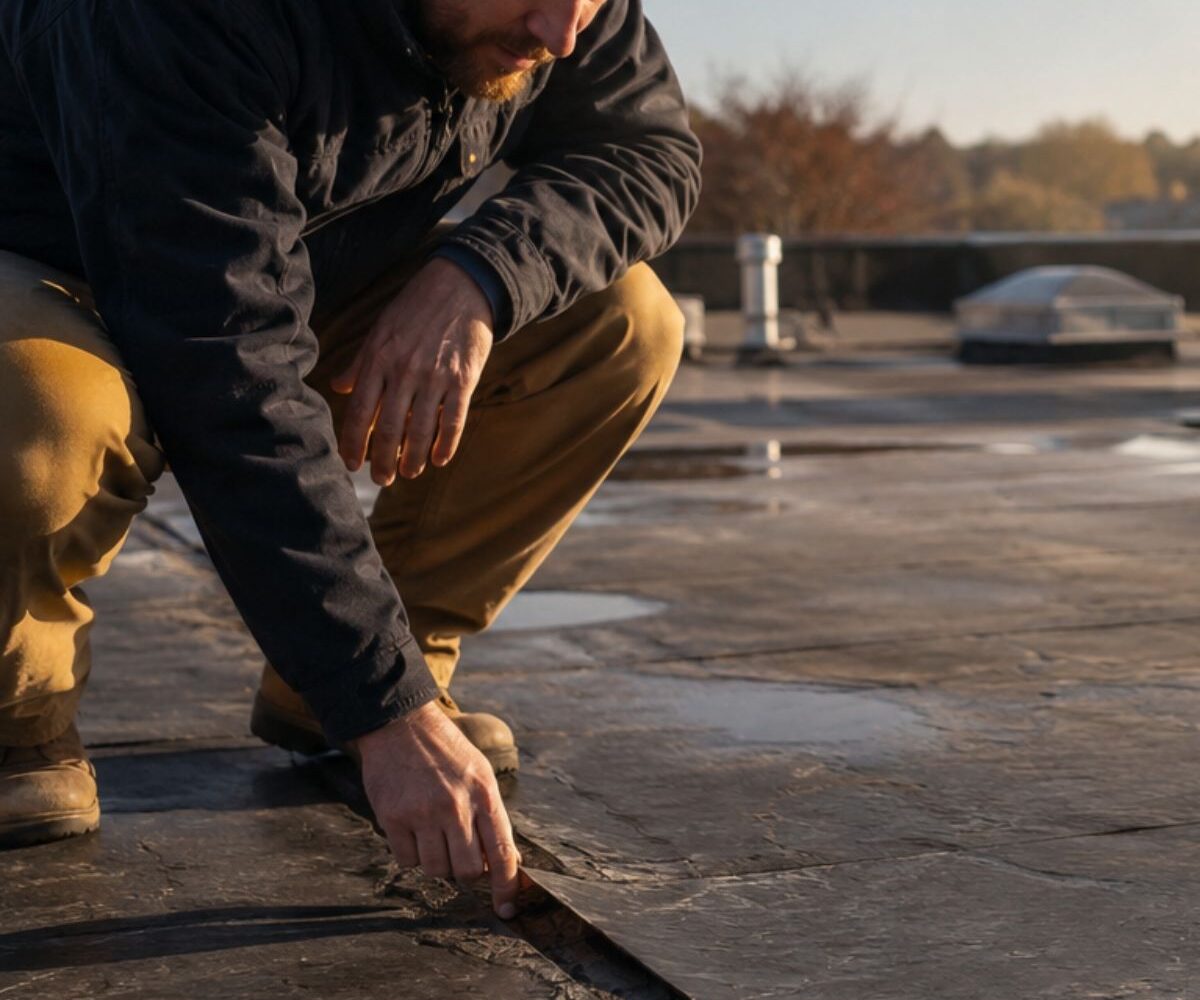
Signs Your Commercial Roof Needs Restoration
Most facility managers don’t find out about what their roof actually needs until they’re already scheduling the third repair call in eighteen months. The signs your commercial roof needs restoration tend to appear gradually, and because each one looks manageable on its own, it’s easy to keep patching rather than stepping back and asking whether it still has the structural integrity to hold a patch.
This article walks through the diagnostic signs, explains what they indicate about your roof’s actual condition, and gives you a framework to decide whether restoration, targeted repair, or full replacement is the right move.
Why Commercial Roofs Degrade Faster Than Most Building Owners Expect
The standard flat or low-slope commercial roof faces conditions that steep residential roofs don’t: water doesn’t shed, it pools; UV exposure across a broad, unshaded horizontal surface accelerates membrane breakdown; temperature cycling in Detroit’s climate, where freeze-thaw swings can be severe, works on seams and flashings year after year. Most commercial roofing membranes are warranted for 15 to 20 years, but real-world performance depends heavily on what happens in years two through eight.
What Silicoat’s team consistently finds is that roofs hitting that mark without a documented maintenance history are already showing substrate damage that doesn’t appear in a visual walkover from ground level.
Proactive roof maintenance changes the math significantly. A roof with minor surface oxidation and isolated seam separation in year ten is a strong restoration candidate. The same roof in year fourteen, after two Michigan winters without maintenance, may have moisture intrusion in the substrate that requires partial or full replacement before any coating will adhere correctly.
The Warning Signs That Indicate a Roof Needs More Than a Repair
Not every roof problem is a restoration signal. Some issues (a small membrane puncture, a flashing separation at a penetration, minor granule loss on a modified bitumen surface) are legitimate repair candidates. What separates a repair situation from a restoration situation is scale and pattern.
Surface alligatoring or widespread cracking
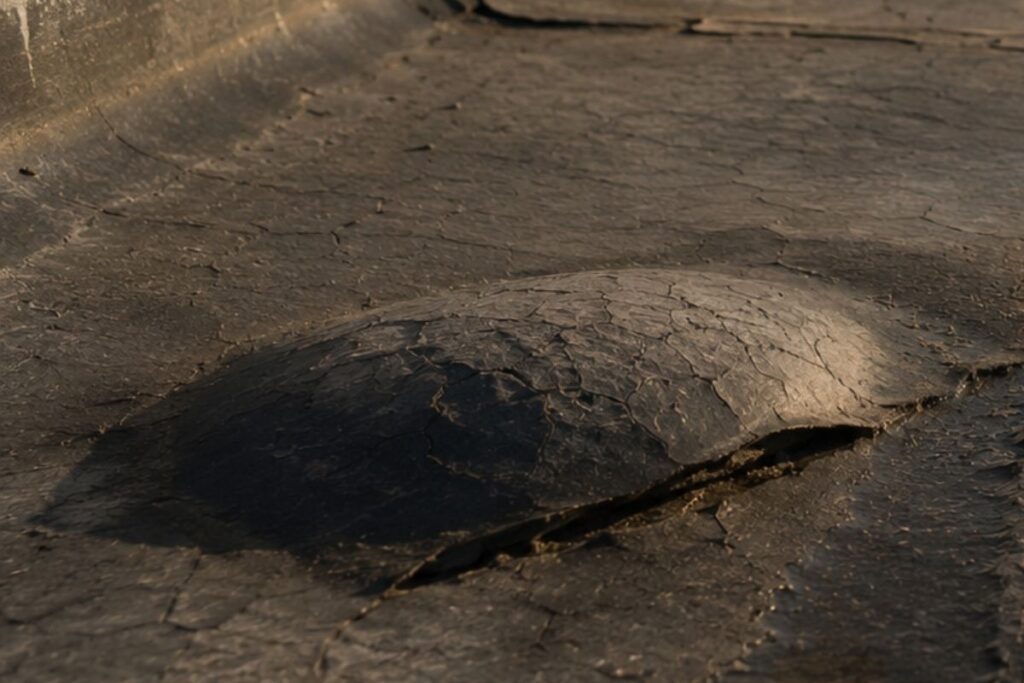
When an EPDM or built-up roof membrane develops a cracked, scaly texture across multiple sections, that’s not a localized failure; it’s the membrane’s plasticizers breaking down. Individual cracks can be filled; a membrane that looks like dried mud across 40% of its surface cannot be repaired to a functional state.
Seam separation appearing in multiple locations
A single failed seam is a repair. Seam failures appearing in different sections of the roof (especially when they aren’t caused by a single physical event) indicate the membrane has lost adhesion integrity broadly. Each new repair covers the symptom without addressing the system-wide condition.
Pooling water that doesn’t drain within 48 hours
Ponding water on a commercial roof is common after heavy rain, but it should drain within 24 to 48 hours through drains and a positive slope. Persistent pooling accelerates membrane deterioration, adds structural load, and creates conditions for accelerated biological growth.
Surface oxidation and loss of reflectivity
A roof coating that has oxidized to a flat grey has lost a significant portion of its UV-reflective capacity. This isn’t just an energy efficiency issue; UV degradation accelerates membrane breakdown underneath. Once oxidation is visible across the main field of the roof, you’re in the window where restoration still makes sense.
Rising interior temperatures or energy costs without an obvious HVAC cause
A degraded roof coating loses its “cool roof” performance. If your utility costs have climbed and your HVAC system checks out, the roof’s thermal performance is worth investigating directly.
None of these signs alone is a verdict, but two or more appearing together, especially on a roof past the 10-year mark, is the pattern that should prompt a formal assessment rather than another repair order.
Seeing two or more of these signs on your building? Silicoat Roofing offers free roof assessments for commercial properties across the Detroit area, no commitment required.
How Restoration Actually Works and Why It’s Different from Patching
Restoration in the context of a liquid silicone membrane system is a fundamentally different intervention than patching. A repair addresses a discrete failure point. A restoration addresses the entire roof surface by applying a new waterproof membrane layer over the existing substrate (provided that the substrate is in adequate condition to accept it).
The process Silicoat uses involves cleaning the existing roof surface, addressing and sealing any active leak points and compromised seams, then applying a liquid silicone membrane that bonds to the substrate and cures into a seamless, flexible waterproofing layer.
The resulting surface meets the criteria for a “cool roof” by industrial classification standards – it reflects UV radiation and reduces thermal gain, which has a measurable effect on cooling load in commercial buildings.
One thing worth stating clearly: silicone coatings are not the right solution for every commercial roof. They are well-suited to roofs where the existing substrate is structurally sound and where moisture intrusion in the underlying insulation is limited. A roof with significant wet insulation, major structural deflection, or widespread substrate deterioration may not be a restoration candidate at all, and an honest assessment will tell you that before you commit to a coating application that won’t hold.
With over 20 years of expertise working on commercial and industrial properties, Silicoat’s team has declined jobs where restoration wasn’t the right answer. The value of a credible assessment is knowing which category your building is actually in.
What the Research Says About Commercial Roof Lifecycle Costs
The financial case for timely restoration rests on a documented pattern in commercial roofing lifecycle cost data. The National Roofing Contractors Association states that commercial roofing systems maintained with proactive coating applications over their service life cost significantly less in total lifecycle cost than roofs managed through reactive repair until failure.
The mechanism is straightforward: roofing system failures don’t degrade linearly. A roof in acceptable condition through year 12 can deteriorate to a replacement-required state within 24 to 36 months under deferred maintenance conditions, particularly in climates with significant freeze-thaw cycling.
What Silicoat’s team consistently finds in assessments of Detroit-area commercial buildings is that the gap between “restoration viable” and “replacement required” is often narrower than building owners expect. Roofs that looked borderline in an October assessment, after a hard winter without intervention, often come back as replacement candidates by March.
The practical implication: if you’re seeing two or more of the warning signs described above and your roof is past the ten-year mark, the cost of waiting to act is not zero. Every year of further degradation narrows the restoration window and increases the required investment.
How to Tell the Difference Between a Restoration Candidate and a Replacement Candidate
A commercial roof is a restoration candidate when the existing substrate is structurally sound, moisture intrusion in the insulation is limited to isolated areas, and surface degradation is primarily cosmetic or membrane-level. Replacement is indicated when structural components are compromised, wet insulation covers a significant portion of the roof area, or multiple failed restoration attempts have already occurred.
This is the most important question. Here’s the framework Silicoat’s team uses in a formal roof assessment. It won’t replace a physical inspection, but it gives you a working model before you call anyone.
The Three-Category Decision Framework
The practical distinction between restoration, repair, and replacement depends on two variables: the substrate’s condition and the scope of damage.
| Category | Substrate Condition | Damage Scope | Recommended Action |
|---|---|---|---|
| Repair | Sound, dry | Isolated, single-point failure | Targeted repair at failure point |
| Restoration | Sound with minor moisture at edges | Surface-level, multiple locations | Liquid membrane restoration |
| Replacement | Wet insulation, structural issues | Widespread or structural | Full system replacement |
The substrate condition variable is the one most often misread by building owners working from visual inspections. Surface damage is visible from a rooftop walkover. Wet insulation is not – it requires infrared thermography or core cuts to diagnose accurately. This is why a credible assessment involves more than a visual inspection.
What Ponding Water Actually Tells You
Ponding water on a commercial roof is a symptom, not a root cause. Persistent ponding (beyond 48 hours post-rain) points to one of three underlying conditions: inadequate drainage design, structural deflection that has created low spots, or drain blockage. Restoration can address the surface membrane’s resistance to water intrusion, but it doesn’t correct structural deflection or drainage design failures. If ponding water is one of your warning signs, the assessment needs to determine which cause is driving it before a restoration decision is made.
What a Roof Past the 15-Year Mark Actually Needs
Age alone isn’t a restoration disqualifier, but it does shift the prior. A 17-year-old roof with documented annual maintenance, limited ponding, and a dry substrate is often an excellent restoration candidate. A 15-year-old roof with no maintenance history, multiple repair cycles, and visible seam deterioration across the field is more likely a borderline or replacement case. Age is an input into the assessment, not a verdict.
Commercial Roof Restoration in Detroit, MI
Detroit’s climate creates specific conditions that affect both the timing of restoration work and the performance of the materials used.
Freeze-thaw cycling is the dominant mechanical stress on flat commercial roofs in southeast Michigan. Water that has infiltrated even small seam gaps expands on freezing, widening those gaps incrementally over each cycle. A roof with minor seam separation in September becomes a roof with significant moisture intrusion by February if the seams aren’t addressed before freeze season. The window for effective restoration work in Detroit generally runs from late spring through early fall, the period when temperatures are consistently above 40°F for proper membrane cure.
UV load in Michigan is lower than in southern climates, which slightly extends the oxidation timeline for reflective coatings. That said, the seasonal intensity during summer months is still sufficient to degrade an unprotected membrane materially over a 3-to-5-year window.
What this means for commercial roof restoration in Detroit is that timing decisions carry real consequences. A building owner who identifies the signs their commercial roof needs restoration in October and defers action until the following spring is accepting one additional freeze-thaw season on a compromised membrane. For a roof already in the borderline restoration range, that can be the difference between a restoration project and a replacement.
“We consistently see buildings where the window to restore rather than replace has closed because one winter happened between when the owner first noticed the problem and when they called. In Detroit’s climate, that’s not an abstract risk, it’s a pattern we see repeatedly.” – Rick Dodaj, Founder, Silicoat Roofing.
What a Realistic Restoration Process Looks Like From First Call to Finished Surface
For a facility manager planning around a restoration project, here’s what the sequence typically looks like:
Assessment
A formal roof analysis identifies substrate condition, active leak points, drainage performance, and the extent of surface degradation. This step determines whether restoration is viable or whether another path is required, as a credible assessment will tell you if restoration isn’t the right answer (even if that’s not what you were hoping to hear).
Scope development
Based on the assessment, a restoration scope is developed covering surface preparation requirements, seam and penetration remediation, and coating specification. The spec affects both performance and warranty terms.
Surface preparation
The existing roof is cleaned and dried, and seams and penetration flashings are reinforced or resealed as specified. Any sections with wet insulation identified in the assessment are addressed before coating application begins.
Membrane application
The liquid silicone membrane is applied across the prepared surface at a specified thickness. Proper mil thickness and coverage rate are critical to performance and warranty validity – this is not a step where cutting material quantity saves money without consequences.
Inspection and documentation
A completed restoration under Silicoat’s process is backed by a 20-Year Leak-Free Guarantee. The documentation of that guarantee requires confirmed application standards.
The realistic project timeline for a mid-size commercial roof in the 20,000-to-50,000 square foot range runs two to four days for application, with the full assessment-to-completion sequence typically spanning two to three weeks, depending on scheduling and surface preparation requirements.
FAQ
How do I know if my commercial roof can be restored or needs to be replaced?
The key variable is substrate condition. If the existing insulation is largely dry and the structural components are sound, restoration is usually viable regardless of surface appearance. Wet insulation covering more than 20 to 25 percent of the roof area is generally the threshold where replacement becomes more cost-effective than restoration.
What does ponding water on a commercial flat roof actually mean?
Ponding water beyond 48 hours post-rain indicates a drainage problem (inadequate slope, blocked drains, or structural deflection). Restoration addresses membrane integrity, but it doesn’t correct underlying drainage design issues, so the assessment should determine the cause before a restoration scope is finalized.
How long does a commercial roof restoration last?
Manufacturer specs for silicone coating systems typically run 15 to 25 years. Real-world lifespan depends on substrate condition at time of application, installation quality and material thickness, local climate conditions, and maintenance practices after application. A restoration on a well-prepared substrate in a maintained building reliably performs at the high end of that range.
Is a silicone roof coating worth it for a commercial building?
For buildings with a sound substrate and a roof in the restoration window, silicone coatings are typically the highest-ROI intervention available. The restored surface meets “cool roof” classification standards, which reduces cooling load, and at roughly half the cost of full replacement, the payback period is measurably shorter than either continued repair or replacement. That said, coatings are not the right answer for every roof – a proper assessment is the only way to confirm fit.
What happens if you delay a commercial roof restoration once you’ve seen the warning signs?
Further surface degradation accelerates, and moisture infiltration into the substrate increases. Once wet insulation crosses the threshold where restoration is no longer viable, the only option is replacement (at significantly higher cost). In Detroit’s climate, a single additional winter season on a borderline roof can move a restoration project into replacement territory.
How often should a commercial roof be inspected?
Twice per year is the standard recommendation: once in spring to assess winter damage and once in fall before freeze season. Buildings with a history of active leaks or ongoing repairs benefit from more frequent inspections. A consistent inspection schedule is also the most reliable way to stay inside the restoration window when it matters.
What Silicoat Roofing’s Assessment Process Actually Looks Like
The signs your commercial roof needs restoration are visible to anyone who knows what to look for. What’s harder to assess without experience is the substrate condition underneath – whether the insulation is dry, whether the structural deck has absorbed moisture, and whether the seam failures visible on the surface represent isolated failures or the beginning of system-wide degradation.
Silicoat Roofing has worked on commercial and industrial properties in the Detroit area for over 20 years. The company’s restoration approach uses a liquid silicone membrane system that bonds to the prepared existing substrate, cures seamlessly, and carries a 20-Year Leak-Free Guarantee on completed work. When the assessment shows that restoration is the right answer, the math on the approach is clear. When it doesn’t, the honest answer is that too.
If this changes how you’re thinking about your roof, the next step is a conversation with Silicoat’s team. Contact us for a free assessment.
About the Author
Rick Dodaj is the founder and CEO of Silicoat Roofing, specializing in commercial roofing solutions that protect businesses and their investments. With extensive experience in commercial roofing, Rick leads a team dedicated to providing cost-effective, long-lasting roofing solutions.
 Previous Post
 Next Post